

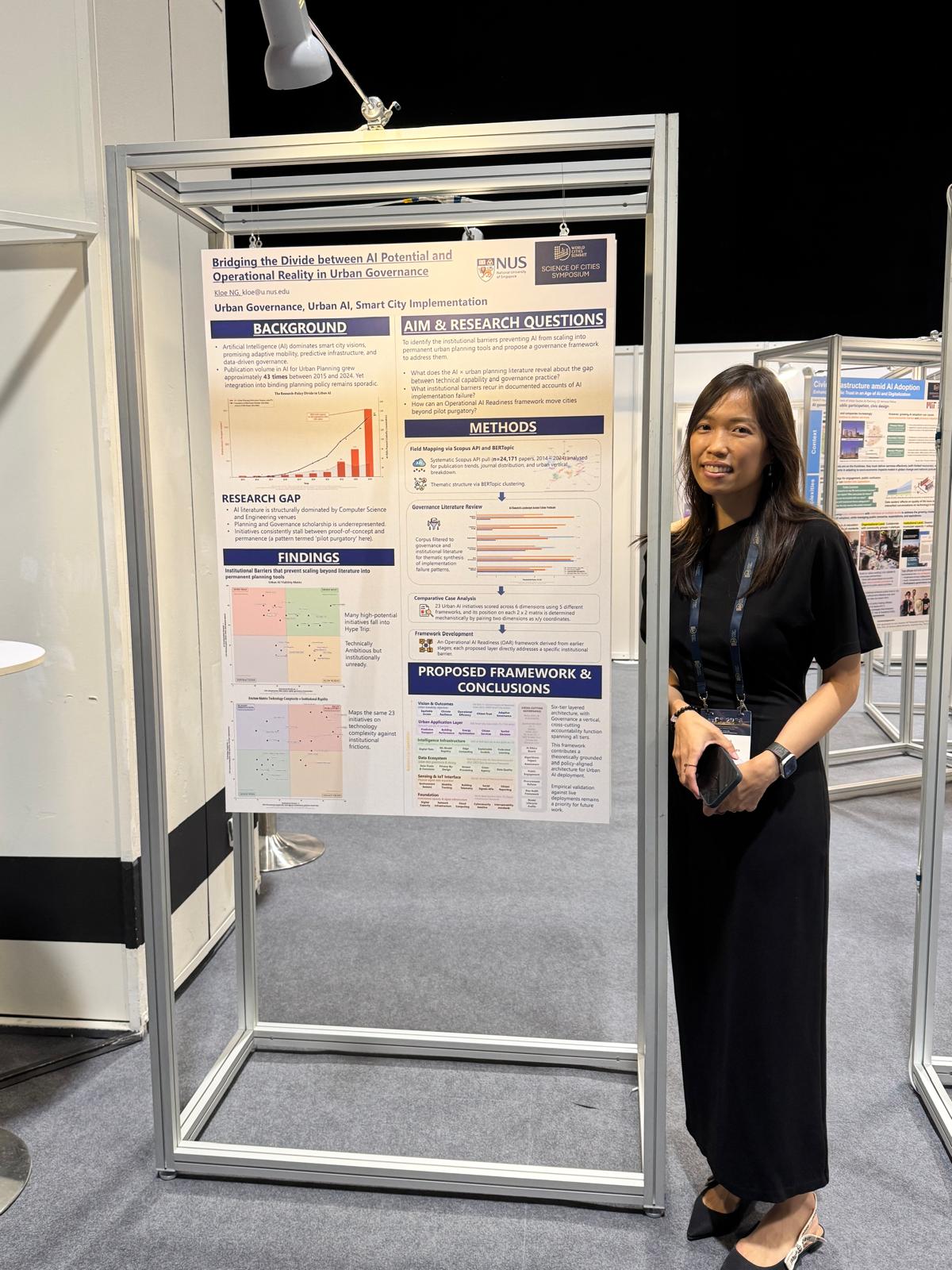
The 10th edition of the biennial World Cities Summit (WCS 2026) convened global city leaders, policymakers, urban planners, and industry innovators under the mandate to Accelerate, Collaborate, and Transform global urban environments. My participation focused on operationalizing next-generation urban intelligence through two primary platforms: presenting an exhibition showcase titled “Bridging the Divide between AI Potential and Operational Reality in Urban Governance” and delivering an address as a selected speaker at the Science of Cities Symposium (SOCS) Young Researcher Spotlight.
1. Exhibition Showcase: Bridging the Divide between AI Potential and Operational Reality in Urban Governance
The WCS Exhibition served as a global staging ground for scalable built-environment and smart city solutions.
Focus & Core Objective: Addressed the critical friction between theoretical AI capabilities and institutional adoption within municipal agencies. The showcase demonstrated practical frameworks for embedding spatial data science, machine learning models, and predictive analytics directly into day-to-day urban planning workflows, regulatory assessments, and resource allocation.
Stakeholder Engagement: Conducted walkthroughs and structured discussions for participants of the symposium, including researchers, visiting mayors and planning directors exploring how to de-risk AI deployment in the public sector.