

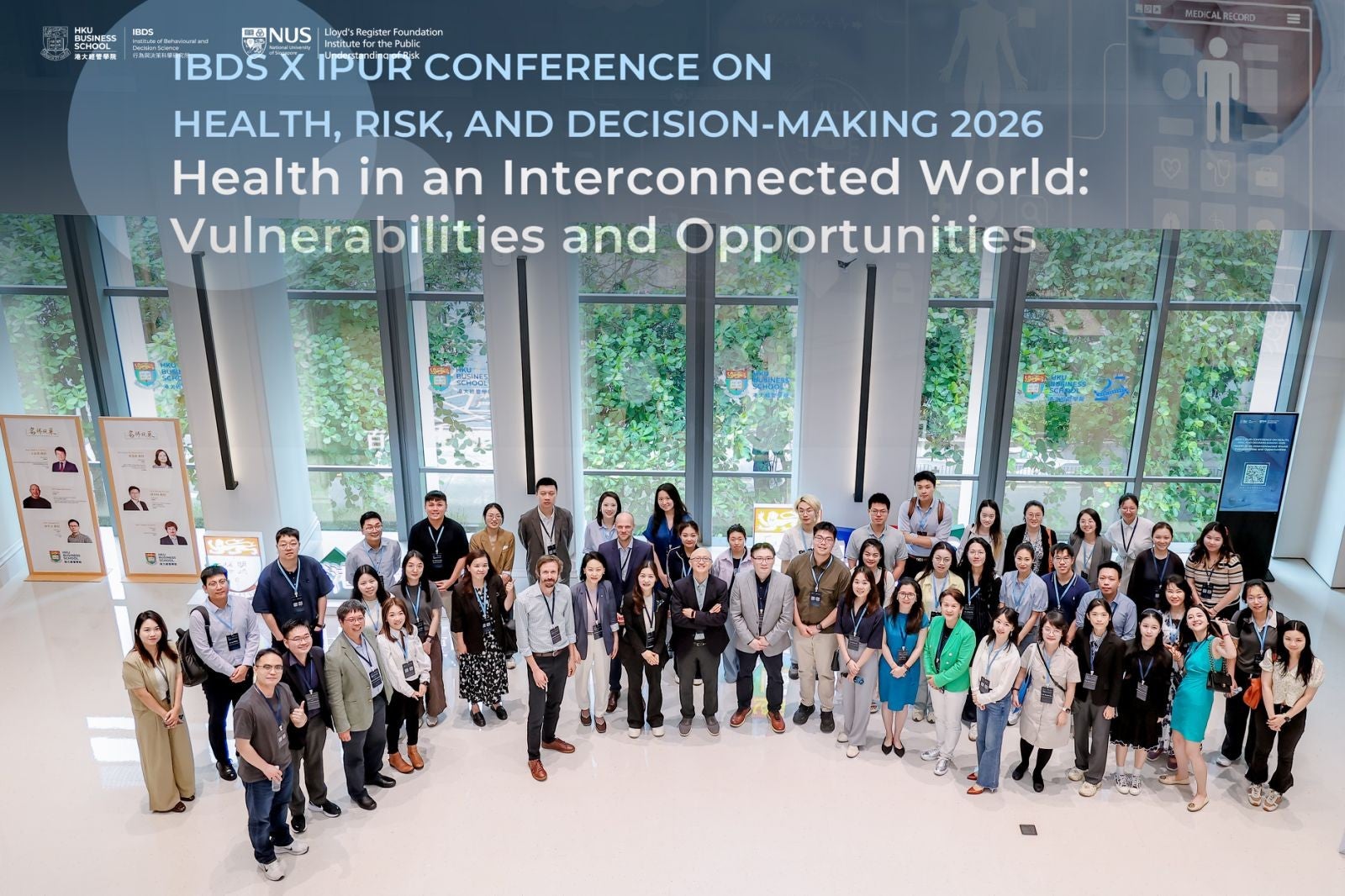
I attended the IBDS × IPUR Conference on Health, Risk, and Decision-Making 2026: “Health in an Interconnected World: Vulnerabilities and Opportunities”, organised by the Institute of Behavioural and Decision Science (IBDS), HKU Business School, and the Lloyd’s Register Foundation Institute for the Public Understanding of Risk (IPUR), NUS . Held on 15–16 May 2026 across Hong Kong and Shenzhen, the conference brought together researchers, healthcare professionals, and industry practitioners to discuss how information, technology, and broader societal changes are shaping health decisions and perceptions of risk
My primary objective in attending the conference was to deepen my understanding of the intersection between artificial intelligence (AI) and healthcare, particularly how AI is being incorporated into healthcare delivery and how patients and other stakeholders may respond to these technologies. From a consumer behaviour perspective, the impact of AI in healthcare depends not only on its ability to improve efficiency and accessibility, but also on whether people are willing to trust, accept, and act on AI-generated recommendations
One particularly relevant presentation was by Prof. Haiyang Yang from Johns Hopkins University, who discussed autonomous medical AI and how reactions to it vary depending on the level and context of AI autonomy. His research illustrated an important distinction between the technical capability of AI and people’s willingness to rely on it. For example, patients may still seek confirmation from a human healthcare professional even after receiving a normal result from an autonomous AI system. At the same time, physicians themselves may face reputational consequences from relying on AI, with peers evaluating physicians less favourably when AI plays a substantial role in their medical decision-making. These findings suggest that acceptance of medical AI cannot be understood simply in terms of its accuracy or functionality. Consumers also make inferences about the legitimacy of the technology, the expertise of those endorsing it, and whether AI is supplementing or replacing human expertise.
A complementary perspective came from Prof. Emanuel de Bellis from the University of St. Gallen. His presentation compared the messages communicated by AI companies, the concerns consumers have about AI, and the issues emphasised in news coverage, revealing systematic mismatches among them that can contribute to public mistrust. This highlighted that consumer responses to AI are shaped not only by their direct experience with a technology but also by the wider information environment surrounding it.
Overall, the conference strengthened my understanding that the successful adoption of AI in healthcare is both a technological and behavioural challenge. A key takeaway for my own research is that studying whether consumers accept healthcare AI requires attention to factors such as the degree of AI autonomy, professional endorsement, availability of human oversight, communication of uncertainty, and the way the technology is positioned relative to healthcare professionals.