

AI Usage Enhances Creative Performance but Leads to Biased Estimates of One’s and Others’ Creativity
Department of Management and Organisation
A brief report from Yamon Min Ye on her research findings presented in the conference.
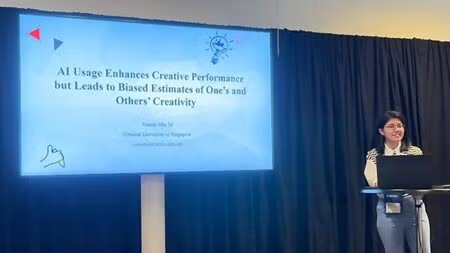
As an incoming third-year PhD student in Management and Organisation, being able to present my research at the 2025 Academy of Management (AOM) Conference was a great opportunity for me. During the conference, I presented two papers, once during a paper session and also during a symposium session. My paper, titled “AI Usage Enhances Creative Performance but Leads to Biased Estimates of One’s and Others’ Creativity,” contributes to current conversations on the role of AI in shaping organisational cognition, creativity, and social evaluation. It was a highly engaging session, and it was fruitful for me to listen to the four other papers during my session as well, which all delve into the intersection between AI and creativity. In addition, receiving questions and feedback from the audience after my presentation helped me to refine my paper better.
My presentation during the symposium session, titled “Effects of Initial AI Use and Competition Outcome on Subsequent Reliance on AI,” contributes to current conversations on the role of AI in creative competitions and users’ subsequent reliance on AI influenced by competition outcome. We were fortunate enough to have a wonderful discussant, Dr. Vivianna Fang He, who provided highly insightful comments and suggestions for moving this project forward, helping me to sharpen the theoretical framing and empirical robustness of my research. It was also an enriching experience to listen to the presentations of the other three papers presented during my symposium session, which all tackle the main question of how generative AI is revolutionising and reshaping the human experience in creative work.
Overall, it was a great opportunity for me to present my research in front of other senior academics to train my presentation and voice projection skills, so that I will be more well-versed and experienced in the future when I do job talks during my job market phase. Furthermore, the networking opportunities presented by the conference during my own sessions as well as when attending other sessions of interest had also been invaluable in expanding my network and increasing my collaboration opportunities with other scholars in the field. Lastly, attending professional development workshops was extremely useful for a junior scholar like myself to gain tips on diverse topics such how to write better theory papers and how to situate my research better in the current research conversations. In sum, presenting at and attending AOM 2025 had deepened my scholarly training and refined my research identity.