

Interview: CGS Director on the Centre’s Journey and Mission

In celebration of its 15th anniversary, the Centre for Governance and Sustainability (CGS) at NUS Business School launched a commemorative e-book titled 15 Lessons in Corporate Sustainability and Governance on 16 May 2025, at an event organised by the school’s alumni office NUS BIZAlum to mark the Business School’s 60th anniversary.
The e-book is a compilation of commentaries on corporate governance and sustainability, many of which were previously published by local and international media platforms and updated for the commemorative publication. It aims to inspire individuals and organisations to embrace the cause through essays on the mindset, implementation steps, communication approach, and talent investments required to integrate sustainability into a business.

Aside from marking CGS’ milestone anniversary, the e-book embodies CGS Director Professor Lawrence Loh’s vision of the centre as a source of practical, understandable information. He noted that the emphasis by the media outlets on clarity and conciseness when reviewing the commentaries for publication has helped ensure that the content remains accessible to business practitioners, students, and policymakers. Prof Loh added that he envisions the e-book as a useful educational tool for his courses and lectures.
“We don’t want to be seen as an ivory tower. We want to be seen as a lighthouse that guides practice and policy,” he said, telling NUS News that his hope is for CGS to eventually go beyond pointing the way to actively leading companies to best practices, like a tugboat guiding ships into safe harbour.
Research with policy impact
Housed under the NUS Business School, CGS was first established as the Centre for Governance, Institutions and Organisations in 2010 with a team of five and an initial focus on corporate governance. Since the beginning, its work has centred on applied research, such as studies to identify baselines or trends among companies, using an integrative approach that leverages industry outreach and collaborations to ensure that its research yields useful insights for managers and policymakers.
Its current projects span corporate governance, corporate sustainability, and the interface between the two, yielding findings that are useful not only to the projects’ funding partners but also to consultants and policymakers who cite them in recommendations and proposals.
All this is accomplished by a lean team of 10, comprising Prof Loh, seven researchers, and two administrative staff, with the help of visiting PhD students on one-year appointments and student interns, research assistants, and Business School faculty members who contribute on an ad hoc basis. Their work has far-reaching impact, garnering the centre over 500 media mentions annually in recent years in local and international media outlets such as AFP, BBC, CNN, China Daily, Nikkei Asia, The Washington Post, and Xinhua News.
Prior to taking over from Professor Chang Sea-Jin as CGS director in 2015, Prof Loh played a pivotal role in adding corporate sustainability to the centre’s scope through his work on the first national study on sustainability reporting in Singapore as a research affiliate in 2014. The centre strengthened its corporate sustainability research pillar over the years with more studies and assessments, and it was relaunched as the Centre for Governance and Sustainability in 2021 to better represent its agenda.
In those early years, the topic was not on the radar for most of the business world, and Prof Loh recalls fielding basic questions like “What is sustainability?” from business leaders.
But CGS’ foresight was rewarded in 2015 when the Paris Agreement on climate change was signed and interest in corporate sustainability skyrocketed. CGS stood out as a reliable source that was already doing work in the field, and its reputation was further bolstered by official recognition and partnerships with regulators and business players, such as the Monetary Authority of Singapore (MAS), the Singapore Exchange (SGX), and luxury group Kering.
For example, in 2013, MAS appointed CGS and the Singapore Institute of Directors as the Domestic Ranking Body to assess and rank Singapore’s listed companies on corporate governance for the ASEAN Capital Markets Forum. The central bank also uses CGS data in its annual financial stability review.
In 2019, CGS was appointed by SGX as an independent assessor to conduct biennial assessments of Singapore-listed companies’ sustainability reporting, and the Singapore Exchange Regulation website lists the Singapore Governance and Transparency Index, a key CGS project, among its sustainability resources for companies.
Since May 2024, CGS has been studying climate- and nature-related transition strategies among companies across Asia Pacific under a three-year collaboration with luxury group Kering, which owns brands such as Gucci and Bottega Veneta.
“Everything we do in CGS is evidence-based,” said Prof Loh, noting that the positions taken by CGS are not based on personal convictions or speculation but derived from data assembled with the help of industry partners and regulators. “Sustainability is not airy-fairy. It has to be factual.”
Prof Loh translates the findings into meaningful insights for businesses through his written commentaries, analysis provided to the media, and speeches at various business events and webinars. These have helped CGS gain mindshare in the business community and promote an evidence-based approach to the sustainability conversation.
Looking back, looking forward
In his 10 years as CGS director, Prof Loh has observed awareness of corporate sustainability evolve significantly, and he believes CGS has helped to drive market behaviour towards greater transparency and sustainability by providing the data to support policy changes and new regulations.
“What we have found over the years to be very interesting is this idea, that ‘What you regulate is what you get.’ As we track company disclosures, we found that whenever there’s a new regulation like a requirement or listing rule, there will be a corresponding change in market behaviour,” he shared.
Business leaders’ questions too have progressed from “Why do we need to care about sustainability?” to “How do we do it?” More recently, the questions have revolved around how much to invest into it, which Prof Loh says reflects a new perspective of sustainability as capital expenditure – a long-term investment – instead of operating expenditure.
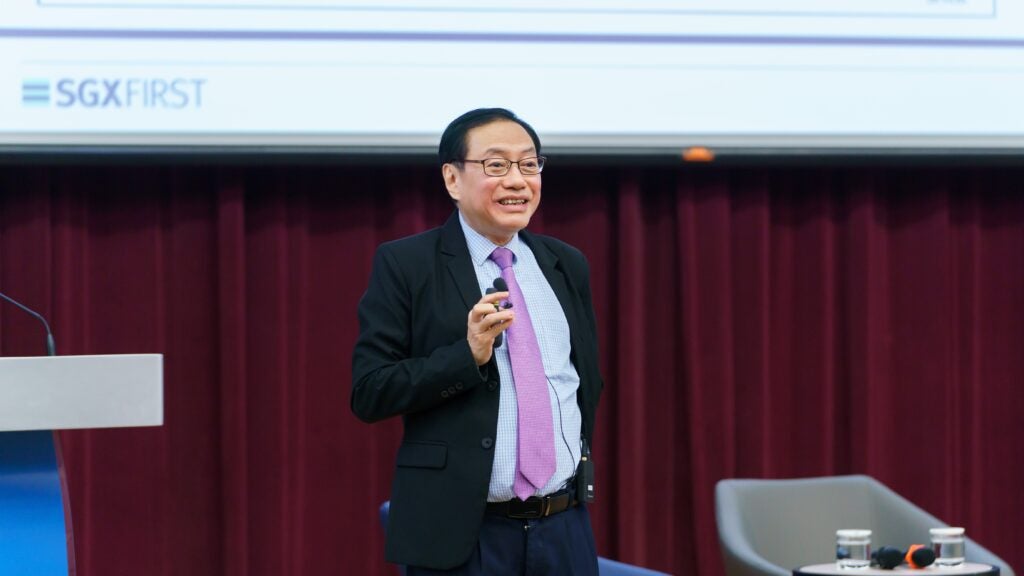
It is an encouraging sign, especially since CGS has been working to get businesses to consider economics alongside the familiar environmental, social, and governance (ESG) framework in their sustainability activities. Prof Loh has shared about this new EESG approach over the past year through opinion pieces and masterclasses like the one he delivered at the e-book launch titled “From ESG to EESG: Incorporating Economics into Sustainability,” in which he built the business case for sustainability efforts that go beyond responsibility and risk management to yield returns.
Even as the work of establishing EESG as the new norm has just begun, Prof Loh looks forward to CGS leading the charge to tackle what he sees as the final frontier of sustainability – fostering a well-being economy that supports human and environmental well-being rather than prioritising economic growth at all cost.
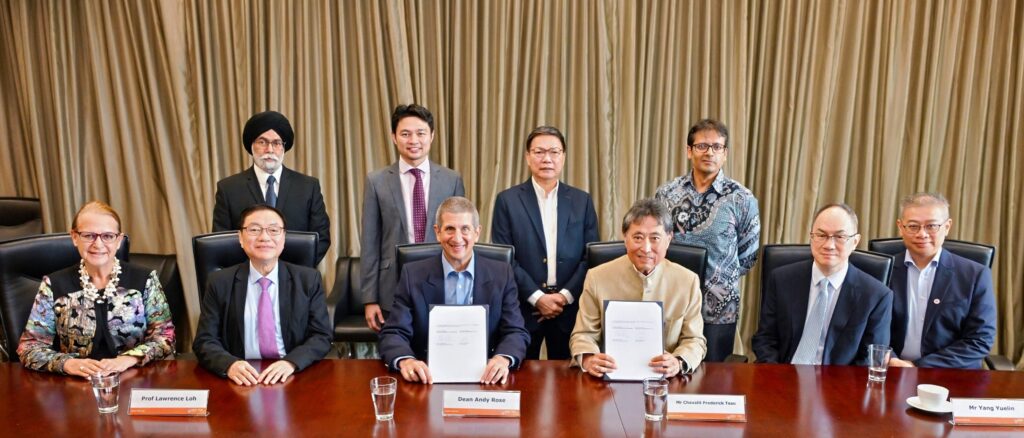
In July 2024, CGS signed a memorandum of understanding with TPC (Tsao Pao Chee) Group to establish the Well-Being and EESG Alliance, which will develop strategies and metrics to guide organisations in embedding well-being into their sustainability efforts.
Said Prof Loh: “In sustainability, looking at climate change is only half the story. An emerging area is human health, and well-being may be the final thing that sustainability is all about – well-being that is holistically defined, not just physically or physiologically, but also psychologically.”
Influencing such major change may seem ambitious for the small research centre, but Prof Loh’s hope is that CGS will not only be recognised for its successes but also rewarded with more resources to scale up its work in its next chapter. After all, the past 15 years have shown that the centre can punch well above its weight, even with limited staff and funding.
“We have reached a certain point where we just need that boost into the next curve, and an investment at this point would help us to ride on the goodwill from our work,” he said. “I think we have not realised our full potential yet.”
First published on NUS News