

CGS-supervised Students Win NUS Outstanding Undergraduate Researcher Prize

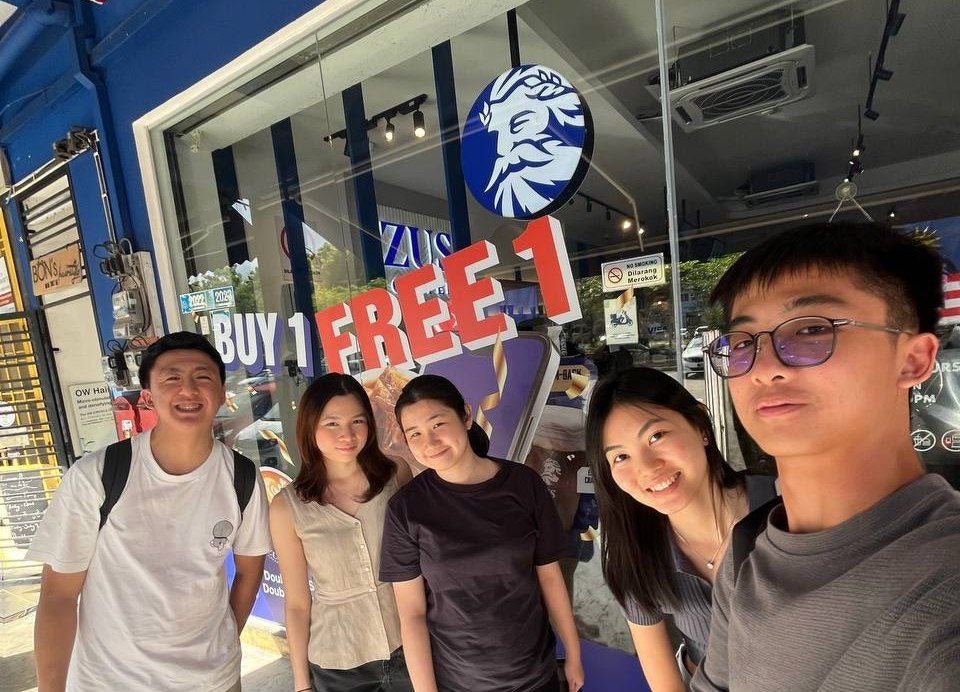
(From left) NUS students Audrey Gabriella, Felishia Darianne, Cyndi Tjoi, Filbert Jonathan Hanjaya and Koh Jun Kai won the NUS Outstanding Undergraduate Researcher Prize with their project “Moving towards a Greener Future with ZUS Coffee”, supervised by CGS Director Prof Lawrence Loh (4th from left).
A student team supervised by the NUS Centre for Governance and Sustainability (CGS) has won the NUS Outstanding Undergraduate Researcher Prize for their sustainability case study on the Malaysian coffee chain ZUS Coffee.
The team, comprising NUS Business School final-year students Felishia Darianne, Audrey Gabriella, Filbert Jonathan Hanjaya, Koh Jun Kai and Cyndi Tjoi, delved into how ZUS Coffee can enhance its sustainability efforts across Environmental, Social, and Governance areas.
Supervised by Prof Lawrence Loh, Director at CGS, the team conducted a competitive analysis of sustainability practices through interviews with industry players and surveys with customers. In addition, they crossed the border to visit six ZUS Coffee outlets in Johor Bahru, Malaysia, to engage with on-ground staff. There were also online consultations with the Sustainability & Strategy team at ZUS Coffee.

This Field Service Project aims to help ZUS Coffee better understand the main sustainability challenges in Malaysia’s food and beverage industry, where high costs, a lack of incentives, and limited collaboration between stakeholders often make it tough to implement green initiatives. It highlights key areas for improvement, such as waste management and packaging recycling, while keeping the process customer-centric.
By analysing the sustainability efforts of other coffee chains (e.g. Starbucks) and environmental best practices in places like Japan, the team also explores how customer expectations—especially among younger audiences—are shifting when it comes to sustainability. These insights aim to support ZUS Coffee in making smart, impactful decisions to strengthen its environmental and social efforts.
Prof Loh commented that the team’s recommendations were not uplifted from other coffee chains, nor generic sustainability solutions, but they were constructed based on desktop research, stakeholder interviews, competitor benchmarking, data analytics and customer insight. “Their innovative ideas—such as gamifying recycling or offering dual-track food waste strategies—position sustainability not as a cost but as a driver of value and engagement,” he said.
For example, in tackling food waste, the team proposed two complementary initiatives—one focused on generating additional revenue through discounted surplus food sales, and another aimed at enhancing brand reputation through food redistribution to the wider community. “Such dual-track solutions demonstrate high creativity and inclusivity, ensuring that the recommendations remain flexible and scalable as the company grows,” added Prof Loh.
Felishia said on behalf of the team, “We’re truly grateful for the opportunity to work with ZUS Coffee. They were incredibly supportive and easy-going, which made the collaboration really enjoyable. Huge thanks to Professor Loh for his guidance and my teammates for their consistency in delivering high-quality work.”
The team’s proposal has received a recommendation letter from ZUS Coffee. In addition, their paper has been published on the CGS website and in the Case Studies Journal.
We congratulate the team on their excellent achievements!