

CGS Podcast Returns with Series 2 “Technology for Good”
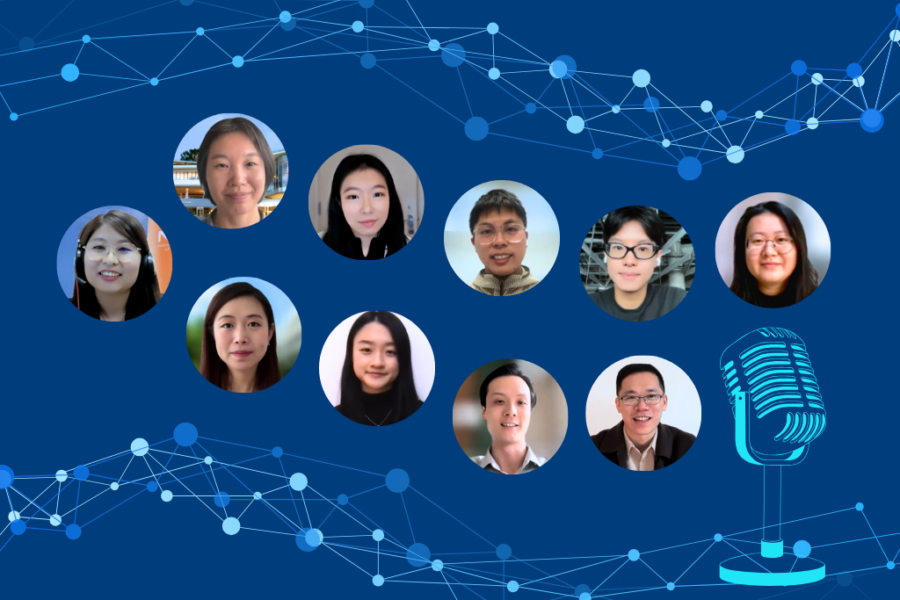
Societal debate about technology and AI has been rife. The focus remains on bringing technology to serve a larger purpose. In Series 2 of its podcast channel “In Words: Insights on Governance and Sustainability”, the Centre for Governance and Sustainability (CGS) at the National University of Singapore (NUS) Business School gathers researchers to talk about how technology can be designed and governed for positive social impact.
The series debuted on 27 August 2026 with Ang Hui Min, CGS Communications Lead, as the podcast host. Streamed across Apple Podcasts, Spotify and YouTube, the series features award winners from the 2025 Tencent-CGS Academic Conference, “Technology for Good: Driving Social Impact”. Held on 19 November 2025, the conference gathered over 100 academics and industry players to discuss inclusive AI, ethics and more. Selected works have been published in the Proceedings of Tencent-CGS Academic Conference (Research Papers and Commentaries, and Poster Submissions).
Now, the seven podcast episodes bring research into accessible ideas for a wider audience. Hear from some of the award winners.
Ep01: Making AI Chatbots More Sensitive to Emotions
Aired: 27 Aug 2026
Zhou Chuanbei from NUS Information Technology discusses how AI chatbots can detect users’ emotions and adapt their responses, helping to protect users’ mental well-being. She was part of the team that received the Excellence Award in the Research Paper category, together with Huang Yi (Centre for Research and Development, Pan-European University, Slovakia) and Zainal Nur Hani (National University of Singapore).
Ep02: Rethinking Gen Z’s Mobile Addiction
Zhang Yiqin from the School of Information Management at Nanjing University explains why digital overuse should not automatically be labelled internet addiction. What matters is the imbalance it creates across social, psychological and physiological well-being, such as fatigue, guilt and disruption to daily life. Her team, comprising Gong Hongcun (Shanxi University), Zheng Yuntian (National University of Singapore) and Deng Sanhong (Nanjing University) received the Merit Award in the Research Paper category.
Ep03: How AI Helps Small Gaming Studios Win Big
Small gaming studios have limited resources to analyse user feedback, but AI can help turn scattered voices into structured insights. In this episode, Lin Fuxin from the School of Management at Zhejiang University explains how this can help smaller studios compete. Together with Wang Dongqi, Chen Zhi and Wu Xiaobo (all from Zhejiang University), and Qiao Qianyue and Fu Xiaolan (both from University of Oxford), Fuxin received an Honourable Mention for their research paper.
Ep04: Different Definitions, Different Regulations
Does the phrase “AI for good” mean the same thing across regions? In this episode, Yuan Zhaoxuan of Hertie School, Germany, and Liu Siyi of University College London explain how different definitions of “a good AI society” are reflected in technology regulations and corporate activities. Together with Mika-Erik Moeser (Hertie School) and Marielle Düh (Berlin Social Science Centre), the team received the Best Commentary Award during the conference.
Ep05: Co-working with AI and the Human Value
In this episode, Li Xina from Singapore Management University explains that our perception of AI—whether we see it as a passive tool or as a co-worker with responsibilities—can reshape how we evaluate our peers and leadership at work. Together with Wesley W. Koo (Johns Hopkins University) and Wei Yang (China Europe International Business School (CEIBS)), Xina received the Excellence Award for their commentary.
Ep06: Can Teenagers Control Their Technology Use?
Aaron Zhu of the National University of Singapore and Cui Shenglan of Hunan University discuss teenagers’ desire for agency and autonomy in managing their technology use. Their research finds that young people may share information to bypass controls, suggesting that technology self-control is relational and that top-down restrictions may not be the best approach—especially in Asian settings with stronger family hierarchies. Together with Janghee Cho (National University of Singapore), the team received the Excellence Award in the Poster category.
Ep07: Digital Collaboration for Social Innovation
Technology for good can be amplified through digital collaboration. In this episode, Qiu Zhenyu from Sichuan Agricultural University explains how online shared documents have enabled people to rally resources in response to floods and public health crises. His insight is that doing good does not always require sophisticated technology; openness, ease of use and collaborative features can matter more. Together with Zhao Chenfang from the Southwestern University of Finance and Economics, China, Zhenyu received the Excellence Award in the Poster category of the conference.
This series highlights how “technology for good” needs to combine innovation with responsibility, human needs, cultural and regulatory contexts. Research in this area is an ongoing endeavour, and a cause that CGS will support.